About Glass Condenser
we provide high-quality laboratory equipment, precision instruments, and durable plastic ware to support scientific research and innovation. Our products are designed to meet the needs of modern laboratories, from academic to industrial settings. We offer a wide range of tools including microscopes, centrifuges, pipettes, and analytical balances. Our plastic ware collection features reliable and chemical-resistant items like test tubes, petri dishes, and storage containers. Each product is carefully sourced and tested to ensure accuracy, safety, and performance. With a focus on affordability and customer support, we are committed to helping your lab succeed.
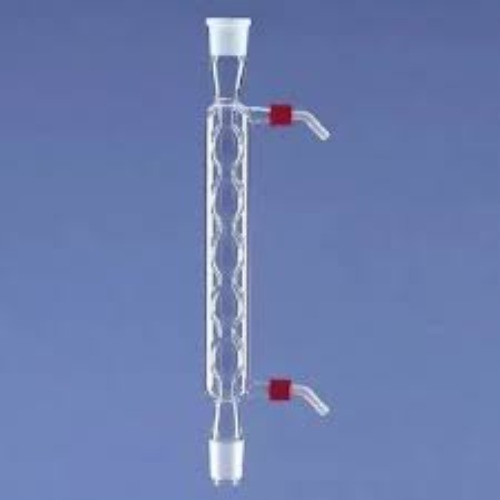
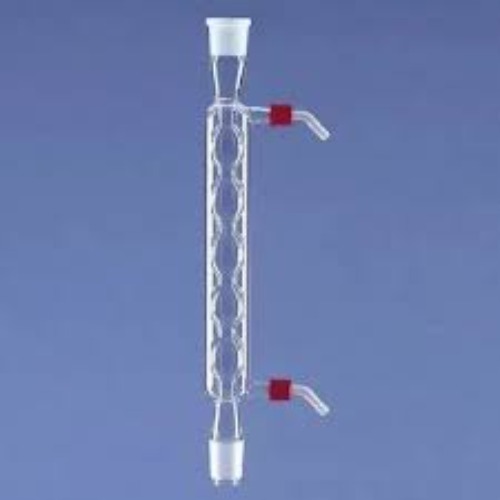
Superior Laboratory GlasswareConstructed from borosilicate glass 3.3, this Liebig condenser provides exceptional resistance to thermal shock and chemicals. Its robust straight cylindrical design and industry-standard 24/29 ground glass joints are compatible with most laboratory setups, ensuring versatility and reliability for both distillation and reflux processes.
Efficient Cooling TechnologyEquipped with water-cooled twin side arms and plastic screw connectors, the condenser delivers efficient vapor condensation and heat exchange. It supports continuous water flow to optimize cooling performance, making it ideal for experiments that demand precise temperature control and high safety standards.
FAQ's of Glass Condenser:
Q: How do I set up the glass condenser in my laboratory distillation apparatus?
A: To set up the condenser, securely attach it to your distillation or reflux apparatus using the standard 24/29 ground glass joint. Connect the water inlet and outlet hoses to the plastic screw connectors, ensuring a tight seal for effective water cooling. Place the condenser horizontally between the distillation flask and receiving vessel.
Q: What applications is this Liebig glass condenser suitable for?
A: This condenser is designed for laboratory-scale distillation, reflux, and vapor condensation processes. Its high chemical resistance and thermal stability make it appropriate for organic chemistry, analytical labs, and educational demonstrations.
Q: When should I replace or clean the condenser?
A: Clean the condenser after each use to prevent residual chemical build-up and contamination. Inspect periodically for any cracks or damage; replace immediately if any structural issues are observed to maintain safety and performance.
Q: Where should I store the Liebig condenser when it's not in use?
A: Store the condenser in a clean, dry area away from direct sunlight and chemicals that may cause corrosion or damage. Use a padded or secure container to prevent accidental breakage.
Q: What is the benefit of the water-cooled twin side arms design?
A: The twin side arms enable efficient water flow through the condenser, maximizing cooling and ensuring rapid condensation of vapors, which increases the overall efficiency and safety of your laboratory processes.
Q: How does the borosilicate 3.3 glass improve the condenser's performance?
A: Borosilicate 3.3 offers high resistance to thermal shock and chemical corrosion, allowing the condenser to withstand rapid temperature fluctuations up to 250C and exposure to aggressive reagents. This greatly extends the condenser's lifespan and usability.
 Send Inquiry



 Send Inquiry

 Send Inquiry


